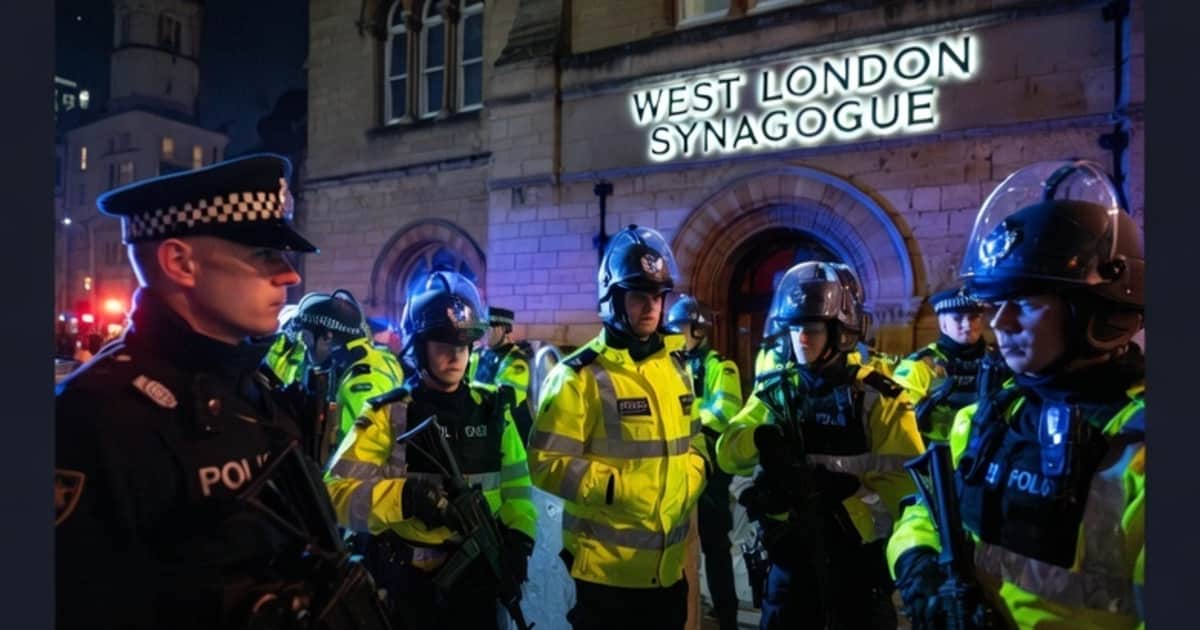
LONDON – Counterterror police in Britain are investigating an arson attack at a former London synagogue that occurred on Tuesday, May 5, 2026. The incident is the latest in a series of antisemitic attacks that have caused significant outrage and fear within the UK's Jewish community. Prime Minister Keir Starmer convened a meeting with leaders from across society on the same day to discuss strategies for tackling the escalating antisemitism.
Minor damage was reported to the gates and lock at the front of the former temple in the Whitechapel area of east London, but fortunately, no injuries were sustained, according to the Metropolitan Police. This event follows a pattern of increasing hostility, including the torching of four ambulances owned by a Jewish charity in March, a previous firebombing of a synagogue, and other attempted arson attacks on Jewish sites. Just last week, two Jewish men were stabbed in what police have officially designated as an act of terror.
Prime Minister Starmer addressed the gravity of the situation, stating to community leaders, “It is part of a pattern of rising antisemitism that has left our Jewish communities feeling frightened, angry and asking whether this country, their home, is safe for them.” He emphasized, “These disgusting attacks are being made against British Jews. But, make no mistake, this crisis — it is a crisis for all of us.”
Escalating Incidents and Potential Foreign Links
The number of reported antisemitic incidents across the UK has seen a dramatic surge since the Hamas-led attacks on southern Israel on October 7, 2023, and the subsequent war in Gaza. The Community Security Trust charity has recorded a significant increase, with 3,700 incidents reported in 2025, a stark rise from 1,662 incidents in 2022.
Adding a layer of complexity to the investigation, authorities are exploring whether these attacks are connected to the ongoing Iran war, which began on February 28, 2026. Police are specifically looking into the possibility that the incidents could be the work of Iranian proxies. This line of inquiry was highlighted by the Associated Press, which reported on the potential links.
Government Response and Legal Measures
In response to the alarming spike in hate crimes, Director of Public Prosecutions Stephen Parkinson announced that hate-crime prosecutions will be fast-tracked to address the surge in antisemitic incidents. The government has also indicated that arts funding will be withdrawn from any individuals or entities found to be promoting antisemitism. Furthermore, Britain had previously raised its national terrorism threat level from "substantial" to "severe" – the second-highest on a five-point scale – following the stabbing attacks, signifying that intelligence agencies consider an attack highly likely in the near future. This heightened alert is attributed not only to the knife attacks but also to broader threats from Islamist and extreme right-wing terrorist elements within the UK.
The Prime Minister's meeting at Downing Street aimed to galvanize a unified response and reassure the community. While the focus remains on domestic security measures and prosecution, the potential for foreign involvement adds a critical dimension to the ongoing investigation, as reported by multiple news outlets including the Associated Press and Courthouse News Service.
Community Impact and Future Outlook
The series of attacks has left many within the Jewish community feeling vulnerable and questioning their safety in the UK. The Community Security Trust's data underscores the scale of the problem, with incidents more than doubling in recent years. The fast-tracking of prosecutions and the government's commitment to addressing antisemitism are seen as crucial steps, but the underlying causes and potential foreign influences require thorough investigation. The coming weeks will be critical in understanding the full scope of these threats and the effectiveness of the measures being implemented to protect the UK's Jewish population and maintain national security.