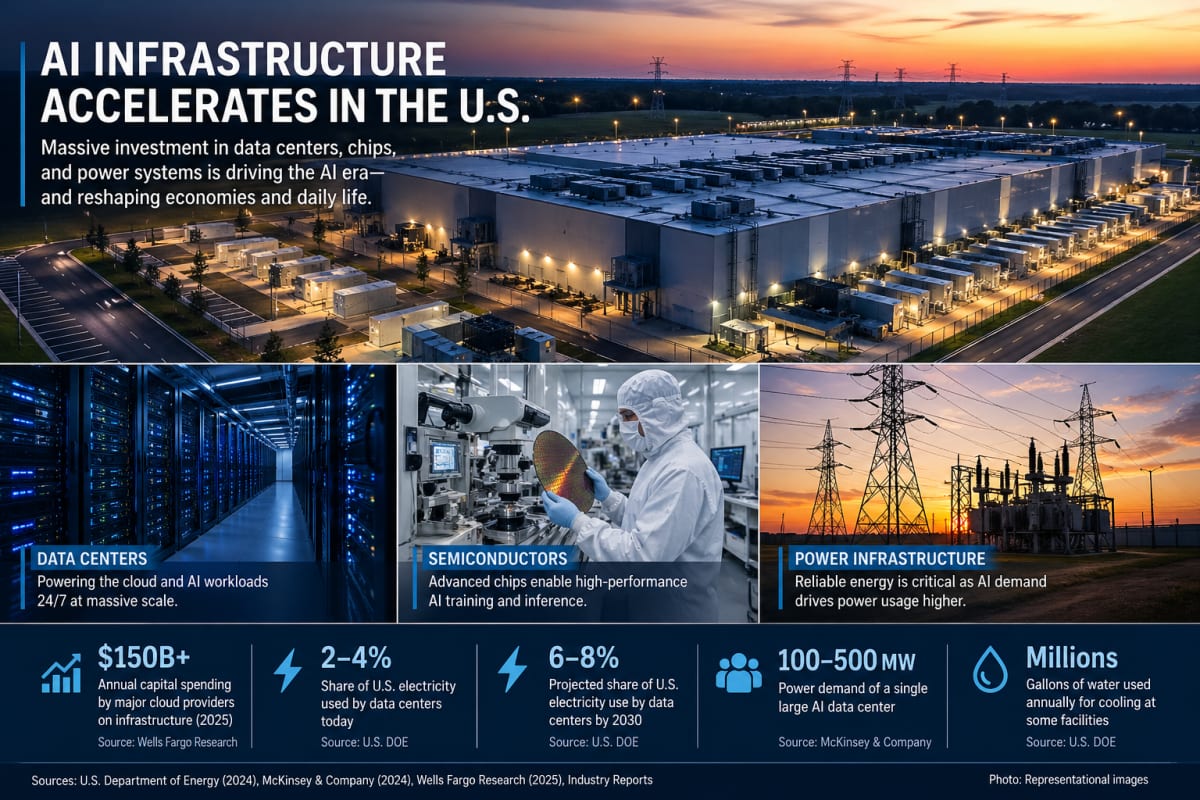
April 27, 2026 — Investment in artificial intelligence (AI) infrastructure is rising sharply across the United States, as technology companies scale up data centre's, secure advanced chips, and expand cloud capacity to meet growing demand for machine learning services.
Combined capital expenditure by major cloud providers is now estimated at over $150 billion annually, with an increasing share directed toward AI-specific infrastructure. Platforms operated by Amazon Web Services and Microsoft Azure are expanding rapidly, while processors from NVIDIA remain central to high-performance AI workloads.
The buildout is highly concentrated in a handful of states. Virginia—already the largest data centre hub globally—continues to attract new projects, alongside Texas and Arizona, where land availability and incentive policies have supported growth. Individual hyperscale campuses can cost $1 billion to more than $10 billion, according to industry estimates.
The expansion is also driving a measurable increase in electricity demand. Data centre's currently account for roughly 2% to 4% of U.S. power consumption, with projections suggesting a rise toward 6% to 8% by the end of the decade as AI adoption accelerates. A single large AI facility can require 100 to 500 megawatts of power, comparable to the consumption of a mid-sized city.
Technology firms, including Google, have committed to increasing the share of carbon-free energy in their operations. However, utilities and regulators are assessing how to integrate large, energy-intensive facilities without placing additional cost burdens on residential users or affecting grid stability.
Economic benefits remain a key driver for state participation. Data centre construction projects can generate hundreds to thousands of temporary jobs, though permanent employment is typically more limited, often ranging from 50 to 200 roles per site. Incentive packages—sometimes valued in the hundreds of millions of dollars—continue to draw scrutiny over long-term fiscal returns.
Water usage has also emerged as a localized concern. Depending on design and climate, some facilities require millions of gallons annually for cooling, prompting increased adoption of alternative cooling technologies.
As AI infrastructure expands, policymakers are weighing the balance between economic development, resource management, and public cost. The pace of investment suggests that these considerations will remain central as the U.S. positions itself in the global AI race.