In an era where digital footprints are meticulously tracked across apps, websites, and devices, a profound disconnect has emerged between public concern and private action regarding data privacy. This phenomenon, often termed the 'privacy paradox,' reveals that while a vast majority of users express significant worry about how their personal information is collected and utilized by Big Tech, a considerably smaller percentage actively take steps to safeguard their data. A recent Cisco survey indicated that 89% of respondents care deeply about their online privacy, yet only 38% reported taking concrete measures to protect it. This discrepancy is not merely an academic observation; it has tangible consequences for individual autonomy and societal power dynamics. The erosion of online privacy is no longer a fringe concern but a central debate shaping our digital economy. Social media platforms, advertisers, and a growing ecosystem of connected devices continuously expand their capacity to monitor our behavior, preferences, and habits. This pervasive data collection is not just about targeted advertising; it has broader implications for personal development, freedom of thought, and the potential for dissent without constant surveillance. Cybersecurity experts warn that this constant monitoring shapes who holds power over our lives, arguing that privacy is fundamental to maintaining freedom of thought, experimentation, and personal development in an increasingly surveilled world. Despite the proliferation of privacy tools and regulations, data exposure remains a significant issue, with billions affected by data breaches annually. Furthermore, the sheer volume of data collected by companies like Google, whose business model is intrinsically tied to data exploitation for personalized advertising, raises alarm. Even with over 160 countries enacting privacy legislation, users are often confronted with complex cookie consent prompts that do little to empower them. The frustration with these controls underscores a deeper issue: a collective awareness of the problem coupled with an inertia in addressing it, leaving the digital landscape increasingly defined by a trade-off between convenience and control.
IT
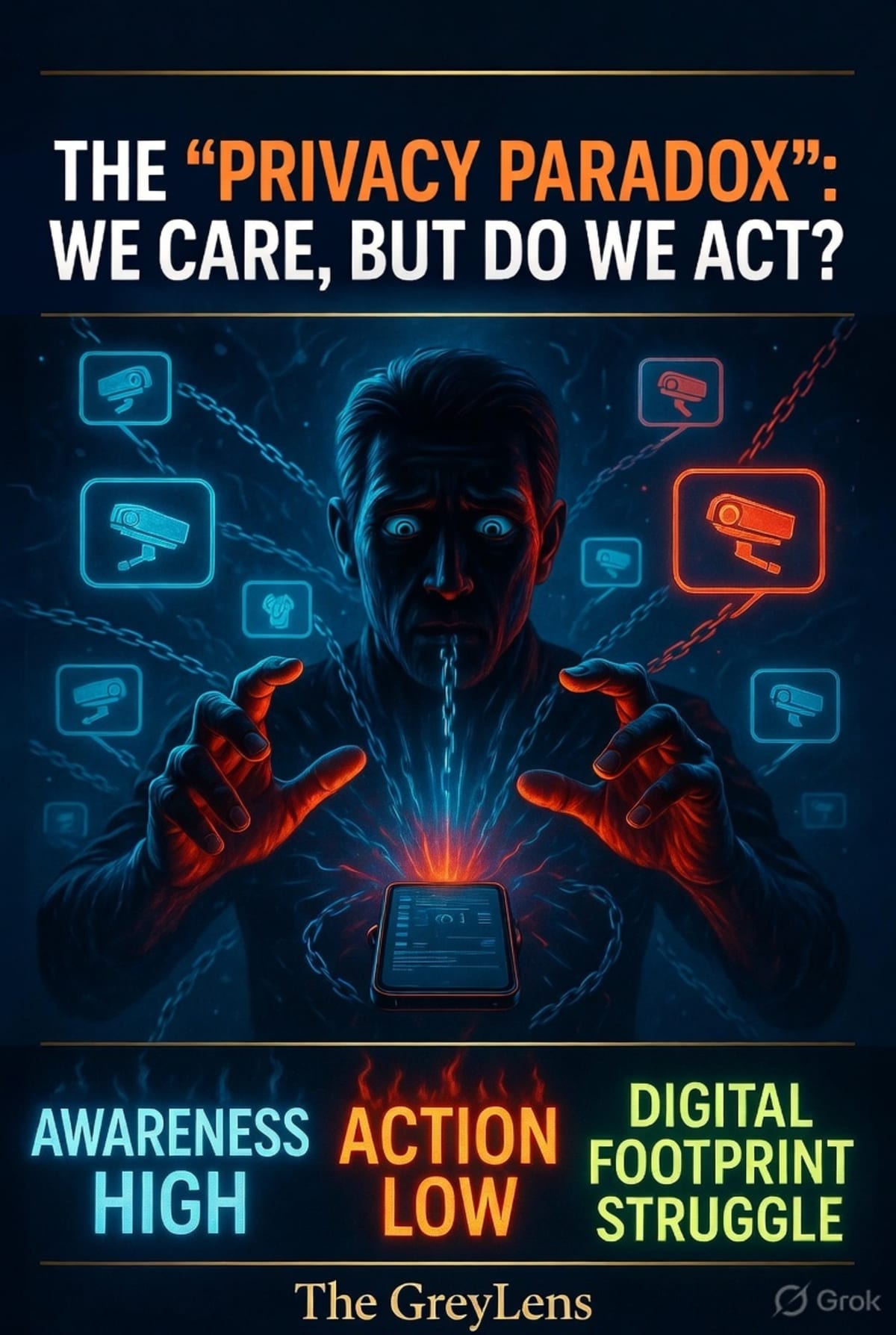
The 'Privacy Paradox': We Care, But Do We Act?
Despite widespread concern over data collection, a significant gap exists between user awareness and their actions. This 'privacy paradox' highlights our struggle to protect digital footprints.
Report an error/suggestion: news@thegreylens.com