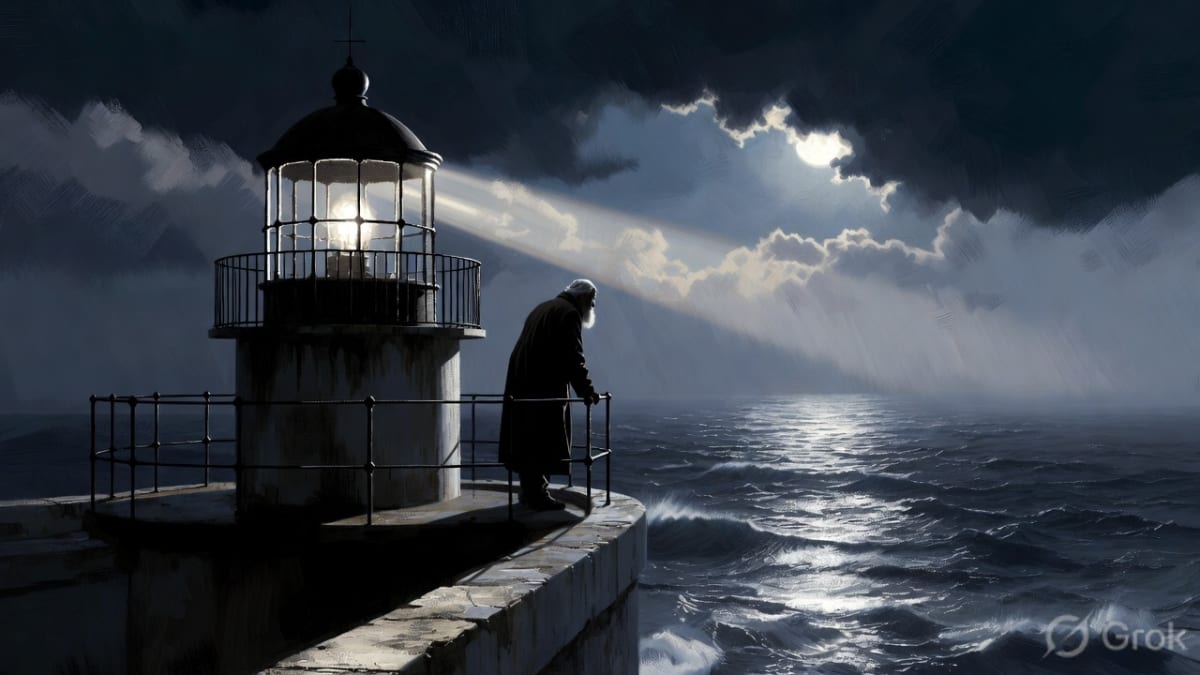
The automation notice arrived on a Tuesday, the same day the storm did.
Elias found the letter wedged under the door of the supply shed, soggy at the edges, ink beginning to run. He read it once standing in the rain, then again inside with a cup of tea he forgot to drink. Your services will no longer be required as of the first of next month. Thirty-one days. After forty-one years.
He was sixty-seven years old and had lived on Cormorant Point since he was twenty-six. He had outlasted two marriages, a brother, and four generators. He had kept the light burning through hurricanes, ice storms, and one earthquake that cracked the tower wall from top to bottom and still, somehow, left the lamp spinning.
He had never once let the light go dark.
That night, the storm made a serious effort. Elias climbed the 112 stairs — he had counted them so many times the number lived in his knees — and sat in the lantern room while the light swept its ancient arc across the water. Through the rain-blurred glass, he could just make out the rocky shelf where, in 1987, he had watched a container ship correct its course at the last possible moment. The captain had radioed afterward to say thank you. Elias still had the transcript, folded small in the tin box under his bunk.
He wondered if the automated system would have a tin box.
By morning, the storm had pushed south. Elias went out to check for damage and found a cormorant sitting stunned on the path — probably struck something in the dark. He wrapped it in an old flannel shirt and set it in a crate in the shed with some fish from his cooler. He had done this perhaps a dozen times over the years. The birds always recovered. Or they didn't, and he buried them near the rocks where they had lived.
In the weeks that followed, he began to notice how much of his life existed in the pauses between tasks. The fifteen minutes he spent watching the sunrise before starting the log. The hour after supper when the light was low and golden and the sea went copper. The way the gulls announced weather three hours before it came, if you knew which calls to listen for.
He tried to write some of it down. He wasn't sure for whom.
On his last night, he climbed the stairs one final time. He sat until the automated system activated itself at dusk — a quiet, mechanical thing, no ceremony, no hesitation. The light began to turn exactly as it always had.
He stayed anyway.
Below, the sea folded and unfolded against the rocks in its patient way, the same motion it had made before he arrived and would make long after. A tanker moved north along the horizon, indifferent and enormous, its own lights winking steadily.
Elias watched until the sky was fully dark and the stars came out.
Then he went back down the stairs, packed his tin box, and left the door unlocked for whoever came next — though he understood, by then, that no one was coming.
The light, at least, would stay on.