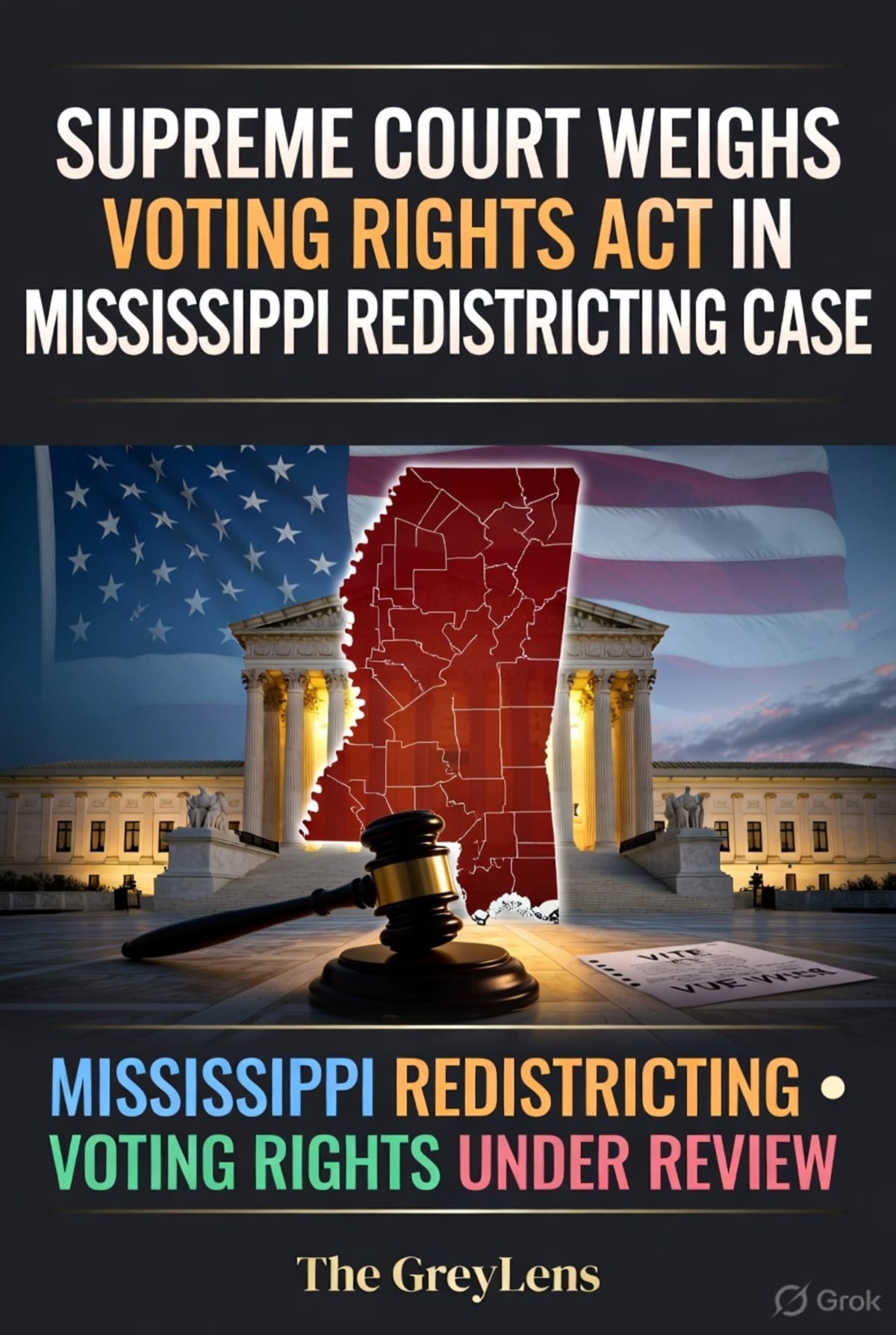
Mississippi Governor Tate Reeves has announced that he will convene a special legislative session for judicial redistricting once the U.S. Supreme Court delivers its ruling in the case of Louisiana v. Callais. This case carries significant implications for minority representation across the nation. During oral arguments held last fall, the Supreme Court appeared to be leaning towards striking down Section 2 of the Voting Rights Act. This section has been instrumental in challenging racially discriminatory election practices. A decision in Louisiana v. Callais is anticipated before the Supreme Court concludes its current term in June.
Overturning Section 2 of the Voting Rights Act could empower state legislatures and local governments to redraw electoral maps, potentially hindering minority voters' ability to challenge districts that dilute their voting influence. While most such redraws might not occur in time for the upcoming midterm elections, the immediate concern for Mississippi is the redrawing of judicial districts for its Supreme Court. A federal judge had previously ordered Mississippi to redraw its Supreme Court electoral map, finding that the existing map violated Section 2 by diminishing the voting power of Black voters. Governor Reeves stated that the lack of a Supreme Court ruling has deprived the Mississippi Legislature of its right to address this violation. In a social media post, Reeves expressed hope that the Supreme Court would uphold the principle of equality for all Americans. The Mississippi Legislature is set to convene its special session 21 days after the Supreme Court issues its ruling in the Louisiana case.
This development comes as the Supreme Court's current term, with a significant number of appointees from President Donald Trump, is considered more conservative. The court's decision in Louisiana v. Callais will determine the constitutionality of Section 2 of the 1965 Voting Rights Act, which was enacted to ensure representation for Black voters. The potential impact of this ruling extends beyond Mississippi, with concerns that it could facilitate the redrawing of congressional districts to benefit Republicans, particularly in the South, by potentially eliminating districts that are majority Black or Latino. The Supreme Court's decision is expected to be a pivotal moment for voting rights in the United States.