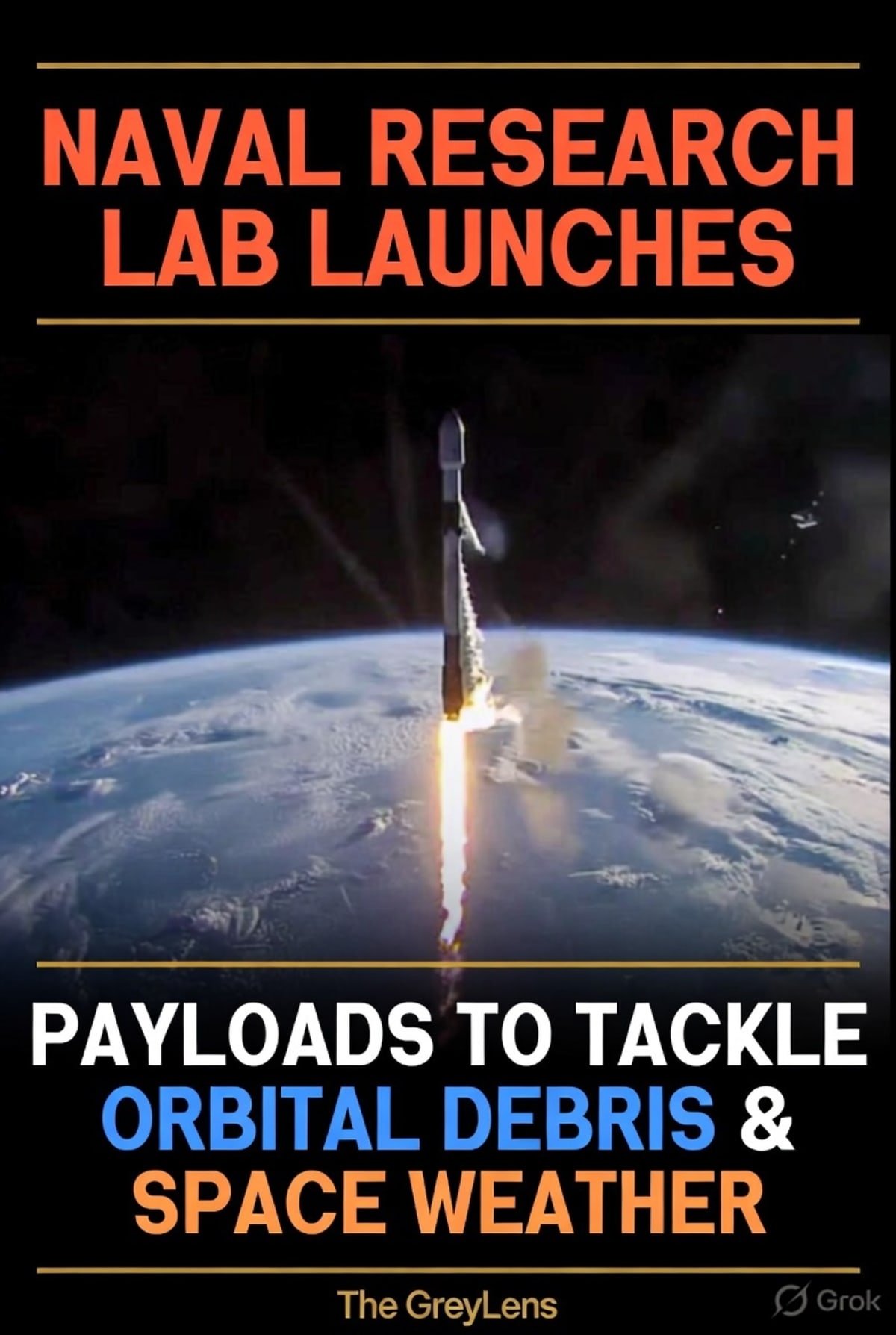
The U.S. Naval Research Laboratory (NRL) has achieved a significant milestone in advancing space-based capabilities with the successful launch of three experimental payloads on the Department of War's Space Test Program's (STP) Satellite-7 mission. The launch, which occurred on April 7 from Vandenberg U.S. Space Force Base, California, utilized a Northrop Grumman Minotaur IV launch vehicle and marks a crucial step in enhancing U.S. national security and maintaining technological superiority in orbit.
Among the deployed payloads is the Lasersheet Anomaly Resolution and Debris Observation (LARADO) instrument, specifically designed to address the escalating threat of orbital debris. LARADO will provide vital data by detecting and characterizing small pieces of space junk that are currently unobservable from Earth. This information is essential for updating orbital debris models, aiding engineers in designing more resilient spacecraft, and informing policymakers. Andrew Nicholas, NRL Sensor Development and Applications Section Head and LARADO principal investigator, stated that the instrument is a critical step towards ensuring situational awareness in space.
Another key payload is the Global Navigation Satellite System (GNSS) Orbiting Situational Awareness Sensor (GOSAS). This CubeSat-compatible, programmable dual GPS receiver is tasked with characterizing the orbital GNSS environment and generating high-quality ionospheric space weather products. Understanding and predicting space weather is paramount for ensuring the accuracy of GPS systems and the integrity of military communications, according to Scott Budzien, Ph.D., NRL research physicist and GOSAS principal investigator. The third instrument, the Gadolinium Aluminum Gallium Garnet (GAGG) Radiation Instrument (GARI-1C), will contribute to the understanding of radiation effects in space.
The STPSat-7 mission, carrying these advanced NRL payloads, is designed to improve the U.S. Navy's understanding of the space environment and test next-generation satellite technologies. By doing so, the NRL aims to ensure the United States maintains its technological advantage and secures critical assets in orbit. This initiative underscores a commitment to bolstering space-based capabilities for national security purposes, addressing emerging threats such as orbital debris and ensuring reliable communication and navigation systems in an increasingly complex space domain.