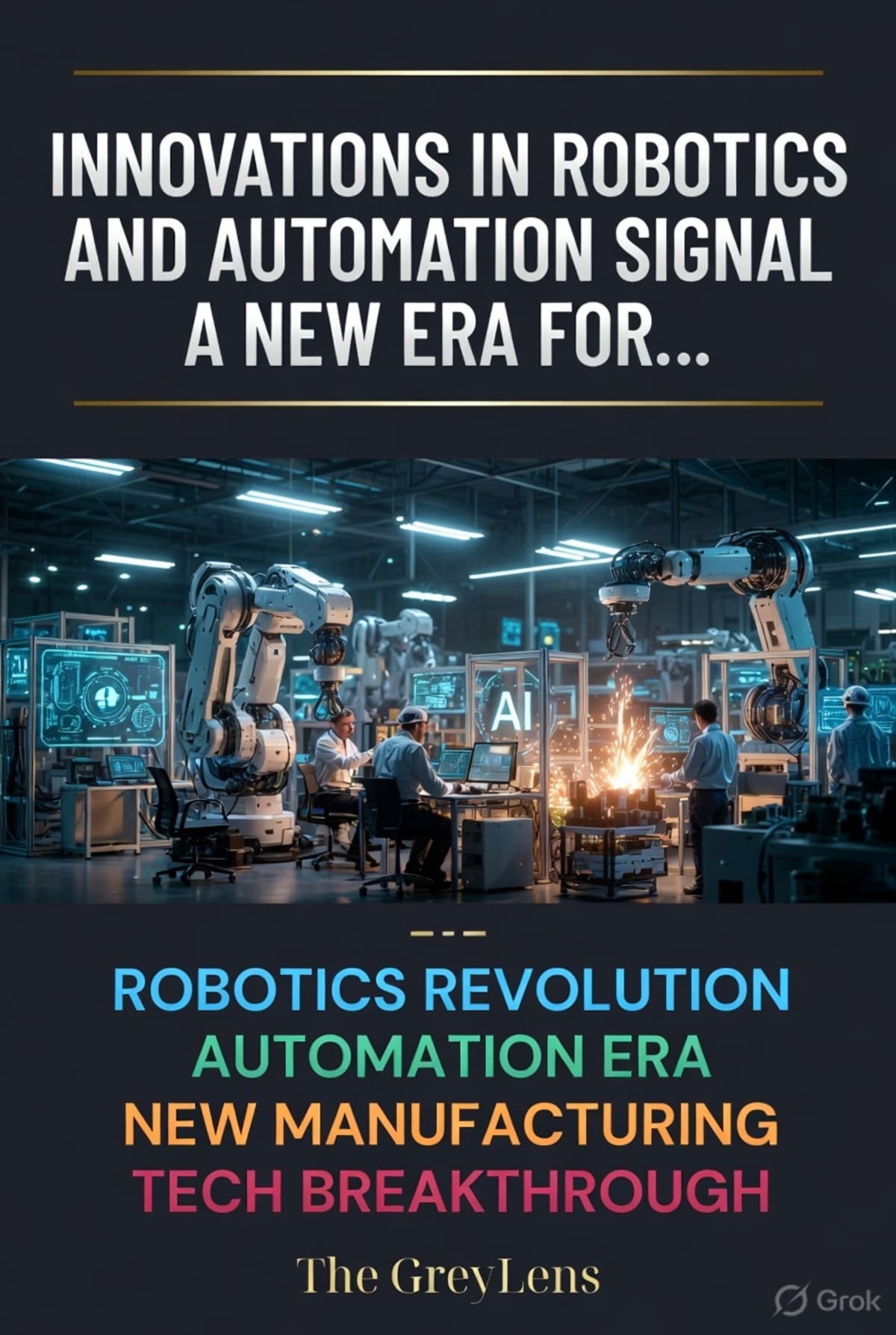
The manufacturing landscape is rapidly evolving with groundbreaking developments in robotics and automation unveiled today, April 21, 2026. A significant announcement comes from KUKA, which has partnered with NVIDIA to introduce \"Automation 2.0,\" a platform that integrates intent-based capabilities and physical AI into its robotics and system integration solutions. This evolution builds upon existing automation frameworks, promising increased flexibility and intelligence for diverse applications, from manufacturing to healthcare. KUKA's CEO, Christoph Schell, emphasized that this expansion aims to enhance, not replace, current automation, positioning the company for continued growth in a competitive market.
Further underscoring the drive towards more adaptable automation, FANUC America has launched the CRX-3iA, an ultra-lightweight collaborative robot. This new cobot is designed for rapid redeployment across small, high-mix tasks, offering manufacturers enhanced portability and ease of setup. FANUC America's general manager, Eric Potter, highlighted the CRX-3iA's role in empowering operators with collaborative automation, noting that expanded features across the CRX lineup will allow for greater application flexibility, from palletizing and welding to complex motion control. In parallel, Milvus Robotics has introduced the SEIT F1500S, a forklift-type autonomous mobile robot (AMR) engineered to optimize material handling in dynamic manufacturing and warehousing environments. This next-generation AMR is designed to replace manual workflows with a safer, more predictable system, boasting a substantial payload capacity and enhanced speed for navigating narrow aisles.
These advancements are further amplified by strategic partnerships and technological integrations. OMRON and Dassault Systèmes have announced a collaboration to bridge the gap between information technology (IT) and operational technology (OT), enabling manufacturers to design, simulate, and deploy production systems through a unified approach that merges virtual and real environments. This IT/OT convergence allows for virtual validation of production systems before physical deployment, aiming to reduce errors and costs. Separately, Rockwell Automation is demonstrating its cloud-connected factory design and industrial operations with AWS at Hannover Messe 2026, showcasing how digital twins, autonomous systems, and industrial AI can foster more flexible and resilient manufacturing. The company's Emulate3D software is being used to create digital twins for virtual factory design and commissioning, illustrating a future where physical operations are seamlessly integrated with cloud-based intelligence. These initiatives collectively point to a future where manufacturing is more intelligent, interconnected, and responsive to market demands.