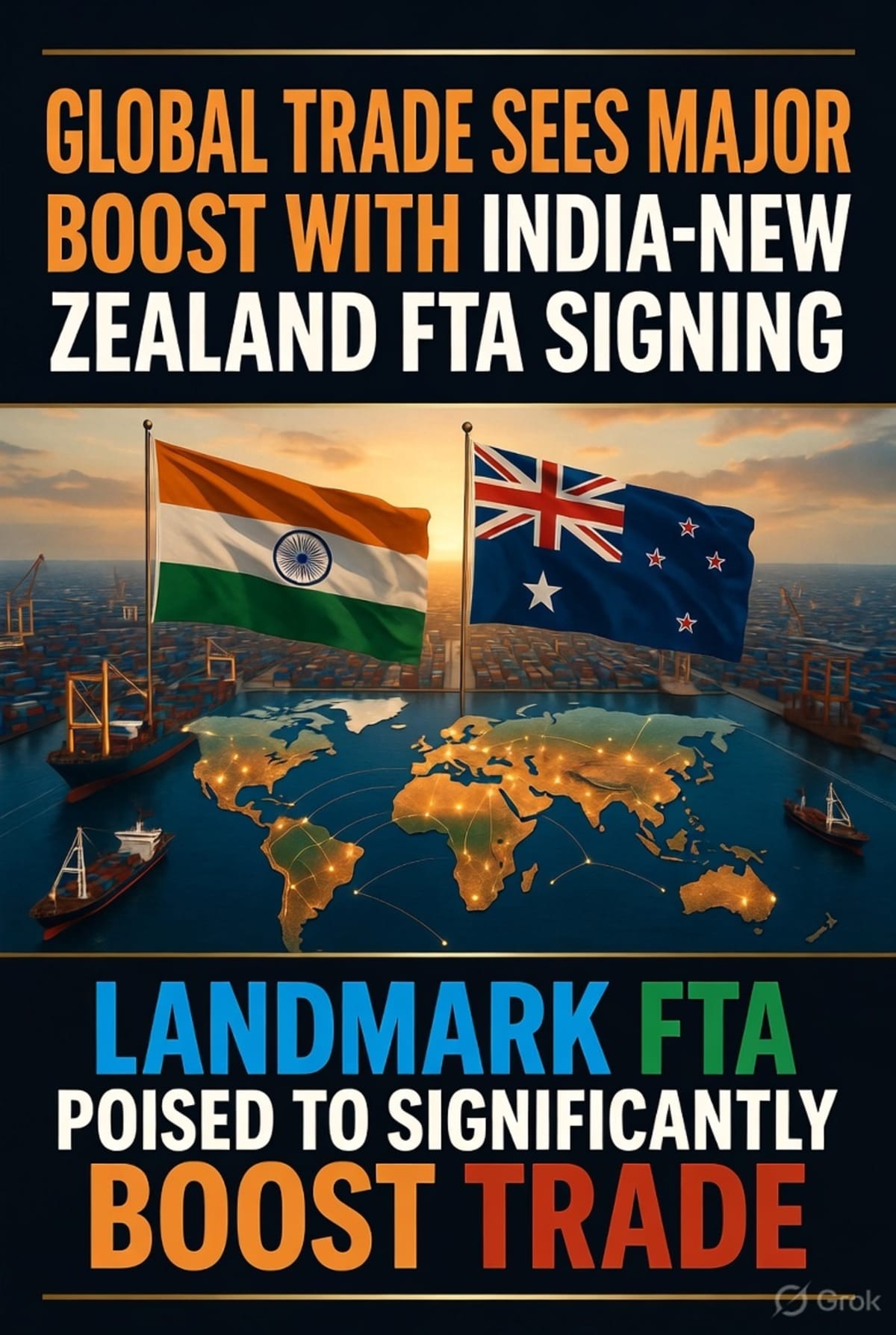
In a significant development for global trade, India and New Zealand officially signed their Free Trade Agreement (FTA) today, April 27, 2026. This pact is expected to provide Indian exporters with 100% duty-free access to the New Zealand market, while tariffs on 95% of imports from New Zealand will be sharply reduced or eliminated. Officials have hailed the agreement as a landmark achievement, projecting it could double trade between the two nations and attract up to $20 billion in investment over the next 15 years. The negotiations for this FTA were notably swift, having been announced in March 2025 and concluded by December of the same year. Indian exports to New Zealand saw a substantial increase of 32.1% in the last full financial year, reaching $711.1 million.
Meanwhile, geopolitical tensions continue to cast a shadow over the global economic outlook. The International Monetary Fund's (IMF) April World Economic Outlook reported a projected slowdown in global growth to 3.1% for 2026, primarily due to the ongoing conflict in the Middle East. This has led to rising commodity prices and firmer inflation expectations, with emerging markets, particularly commodity importers, facing the most significant impact. The IMF also noted a potential rise in global inflation in 2026 before it resumes its decline in 2027. The report outlines several scenarios, with global growth potentially constrained to 2.5% in an adverse scenario of broader regional instability, and reaching as low as 2.0% in a severe disruption scenario.
Adding another layer to the complex global economic landscape, China is reportedly expanding its economic pressure tools in its rivalry with the United States. Beijing has enacted laws to punish foreign firms shifting supply chains, tightened rare earth licensing, and banned foreign AI chips from state-funded data centers. These measures signal a strategic move to counter U.S. actions and defend China's interests. Experts suggest that China is using the current trade truce to build a more robust set of economic influence tools, a strategy that could shape future trade dynamics ahead of anticipated high-level meetings between U.S. and Chinese leadership.