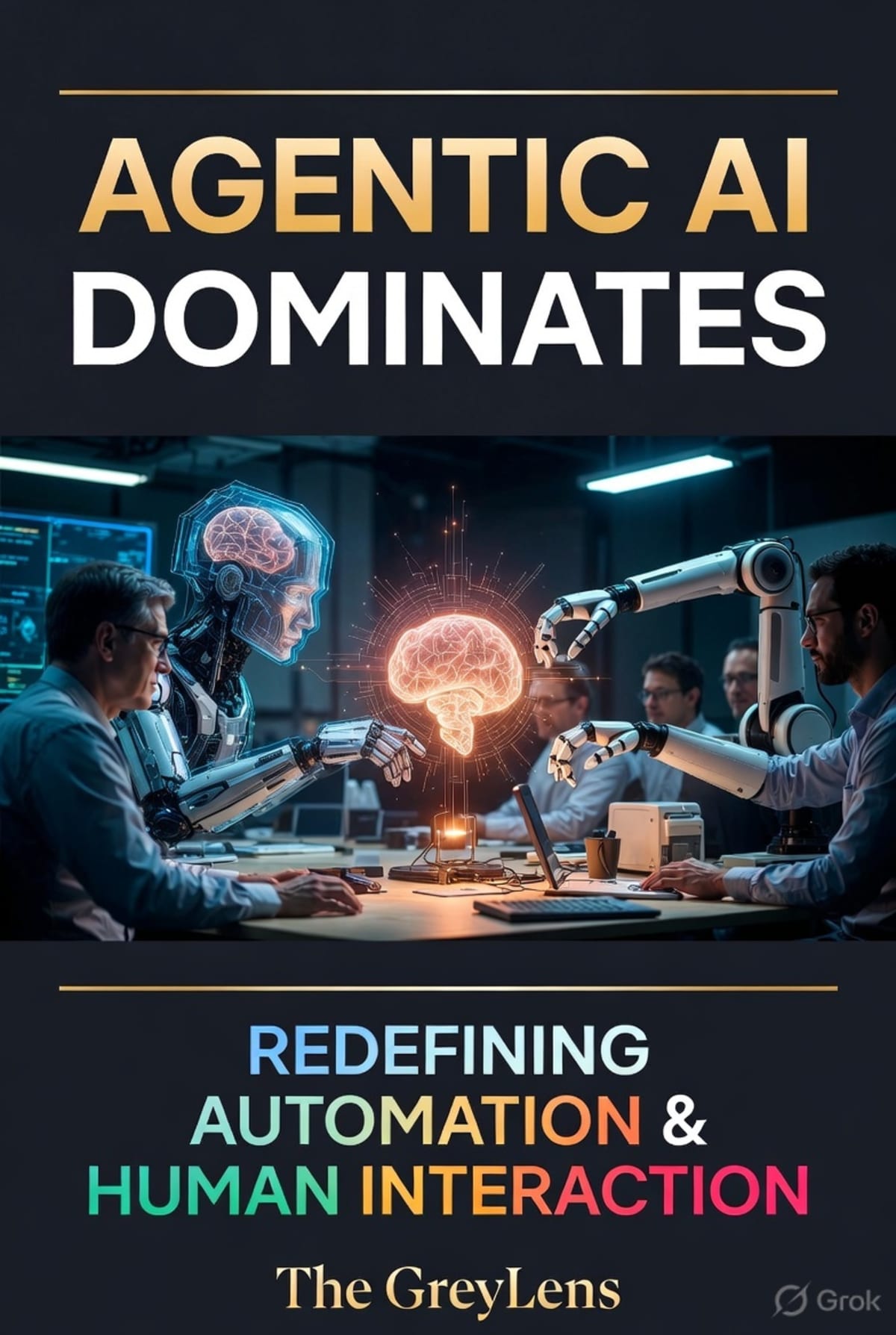
The artificial intelligence landscape in April 2026 is being fundamentally reshaped by the ascendance of Agentic AI, moving beyond simple chatbots to sophisticated systems capable of understanding high-level objectives and executing them autonomously. This evolution signifies a transition from AI as a reactive tool to a proactive participant in the global economy, according to industry analyses. These agentic systems are designed to break down complex goals into actionable steps and operate across various disparate software environments, driven by breakthroughs in reasoning capabilities and API integration architectures. This marks a significant departure from earlier generative models that were primarily focused on single-query responses or content creation.
This paradigm shift is further underscored by advancements in native multimodality, where AI models can now simultaneously process and generate content across text, image, audio, and video within a single neural network. This integrated approach allows AI to perceive and interact with the real world in a more holistic manner. Concurrently, the hardware landscape is evolving with the commercial viability of neuromorphic computing, designed to mimic the human brain's neural structure for more efficient processing of advanced neural networks.
Major technology conferences and industry reports from April 2026 highlight these trends. Events like ODSC AI East and the Global Embodied AI Innovation Summit feature extensive discussions on agentic AI, physical AI, and the integration of AI with robotics. The development of AI coding agents, capable of understanding entire repositories, refactoring codebases, and executing tasks end-to-end, is also a major focus, signaling a new era where developers increasingly direct and review AI-generated code rather than writing every line themselves. Furthermore, the release of advanced AI models like GPT-5.5 and Gemini 3.1 Pro demonstrates continued rapid progress in performance across various benchmarks, including agentic capabilities and multimodal understanding. The industry is witnessing a move towards deep, domain-specific AI, with specialized models emerging for sectors like law and pharmaceuticals, indicating a future where AI is not just general-purpose but highly specialized for economic value.
While AI adoption is nearly universal, reports also highlight a challenge in translating this adoption into measurable business impact, suggesting a growing divide between organizations effectively operationalizing AI and those still in the experimentation phase. The ongoing development and integration of these sophisticated AI systems are poised to redefine human-computer interaction and enterprise automation for years to come.